The Global Professional Body forAI Governance

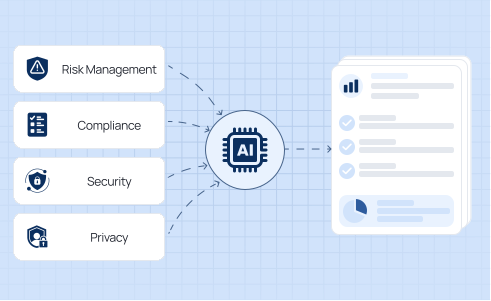
AI decisions affect real people. Governing AI is split across many professions. RESAIA gives each discipline a defined scope, defines what passes between them, and makes governance traceable from strategy to operational evidence.

Governance distributed across independent functions

When governance responsibility is partitioned by function without defined interfaces between them.

Four governance teams separately assessing the same AI system.

Duplicated assessment

A credit scoring model undergoes risk assessment for consumer harm and, separately, compliance assessment for regulatory exposure. Both evaluations examine the same artefact against overlapping criteria, on independent schedules, in formats determined by their respective reporting lines.
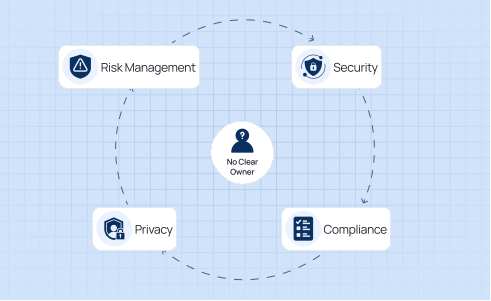
Governance teams surrounding an AI risk with no clear owner.

Unassigned responsibility

Fairness evaluation of a procured foundation model requires three inputs held by three functions: training provenance, which the vendor controls; contractual leverage, which sits with procurement; and the applicable legal standard, held by compliance. No function can complete the evaluation independently.

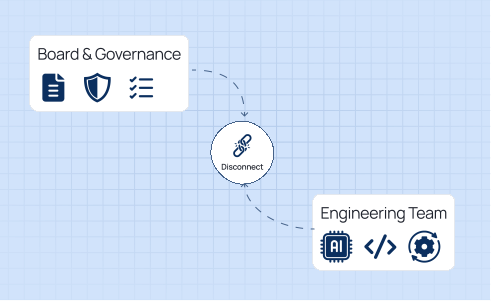
A disconnected path between board governance and the engineering team.

Policy that reaches no further

A board approves a risk appetite statement. For that statement to constrain model selection, it must be translated into a specification requirement or a release gate. Absent that translation, approval is the last point at which the statement has effect.

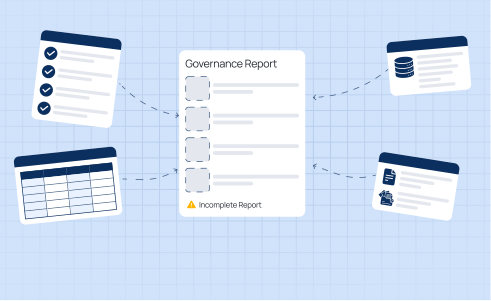
Several evidence sources feeding an incomplete governance report.

Non-reconcilable evidence

A regulator requests evidence that a decision was governed end to end. Risk produced an assessment, compliance a report, security an evaluation. Each addresses a distinct question for a distinct reader, and reconciling them into a single account is manual work performed after the request arrives.

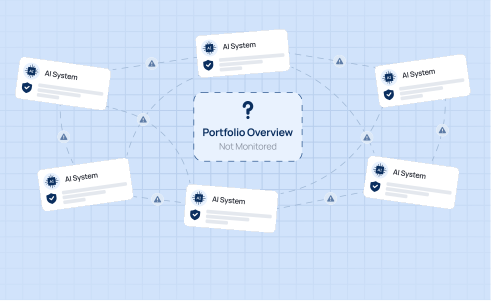
Disconnected AI systems surrounding an unmonitored portfolio overview.

Portfolio concentration

Each system passes review on its own terms. System-level review does not count shared dependencies: how many deployed systems draw on a common vendor, or on the same underlying model. The concentration is measurable and goes unmeasured.

Unspecified in existing standards

Coordination between disciplines is the first requirement. Three further specifications remain open.

From principle to measurement

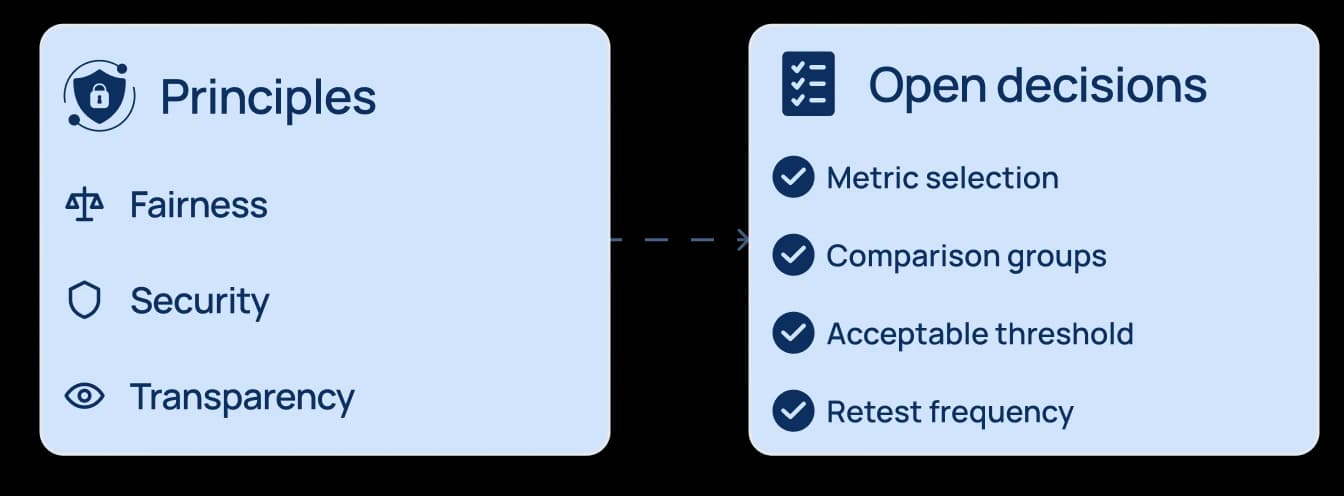
Existing frameworks establish fairness as a requirement. Fairness admits multiple formal definitions, and two accepted metrics can return opposing verdicts on the same model. Selection of metric, choice of comparison population, and the threshold constituting acceptable performance are left to the implementing team.

Principles of fairness, security, and transparency leading to open decisions on metric selection, comparison groups, acceptable threshold, and retest frequency.

Systems that act rather than predict

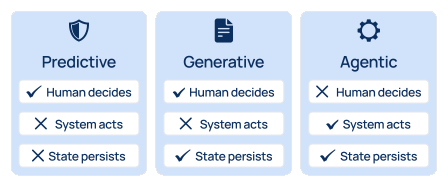
Established method assumes a person acts on the system's output. Systems that act directly and keep state across sessions shift what needs controlling: the limits of permitted action, and the record of what was done.

Predictive, generative, and agentic AI compared on whether a human decides, the system acts, and state persists.

End-to-end traceability

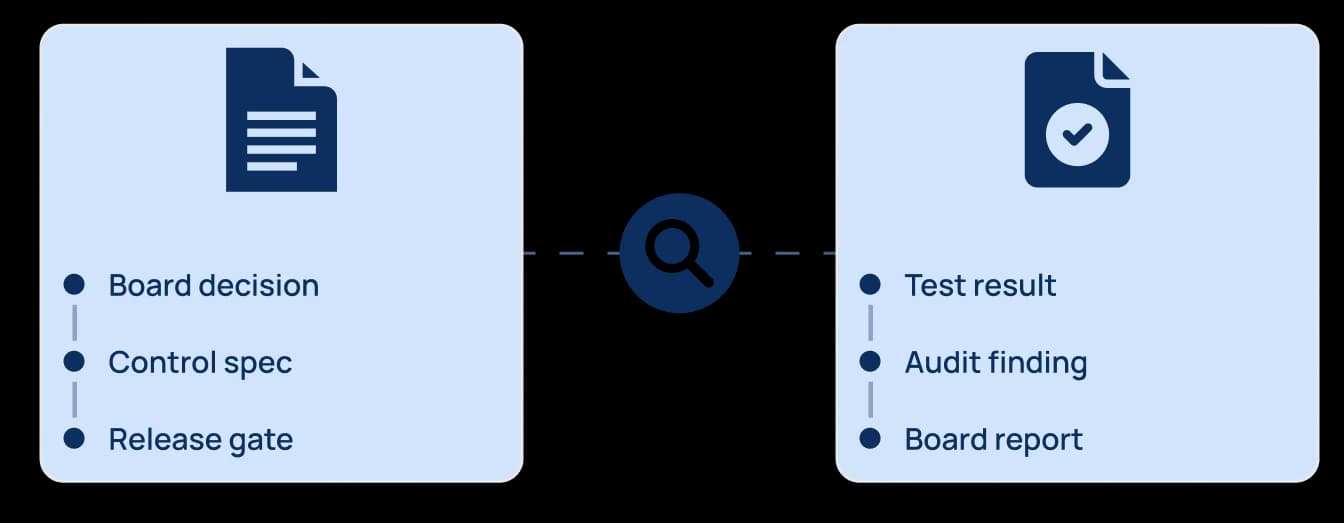
Trace a board decision on acceptable risk to the control implementing it, then to the audit that verifies it. The trace holds only where each document references its predecessor. Maturity assessed discipline by discipline hides the dependency: risk capability is bounded by data governance capability.

A trace from board decision, control spec, and release gate to test result, audit finding, and board report.

The Framework

Every layer answers a question. Every pillar owns a domain

The framework organises AI governance into four layers. Governance sets the direction within which the other three operate. Safeguard specifies what must be protected, Operate delivers systems within those constraints, and Assure verifies the result independently of the personnel who produced it. The Enable layer spans all four, supplying the platforms, competencies, and working practices on which they depend.

RESAIA AIG Framework

Directives flow from each architectural layer into its governance pillars, and evidence flows back from those pillars to the layer.

Governance Foundation

Why govern?

Directives flow from each architectural layer into its governance pillars, and evidence flows back from those pillars to the layer.

Safeguard

How protect?

Directives flow from each architectural layer into its governance pillars, and evidence flows back from those pillars to the layer.

Operate

What execute?

Directives flow from each architectural layer into its governance pillars, and evidence flows back from those pillars to the layer.

Assure

Is it working?

Assessment shows which domain to strengthen next

Each domain is scored on its own rather than averaged into a single number. Lifecycle gates cannot operate above the maturity of the risk assessments that feed them, so strength in one domain does not compensate for weakness in another it depends on.

  1. Initial

    Governance depends on individual initiative. No documented policy exists, and activity follows incidents rather than preceding them.

  2. Developing

    Policy is approved but covers a subset of the portfolio. Requirements are documented without being systematically enforced.

  3. Defined

    Methodology is documented, approved, and applied consistently across the portfolio.

    First stable plateau

  4. Quantitatively Managed

    Performance is measured against defined targets. Evidence-based decision replaces judgement-based assessment.

  5. Optimising

    Governance adapts to emerging capability and regulatory change before adaptation is required.

The design decisions

Why the framework is built this way

Defined scope and interfaces

What each domain produces, and which domains consume it

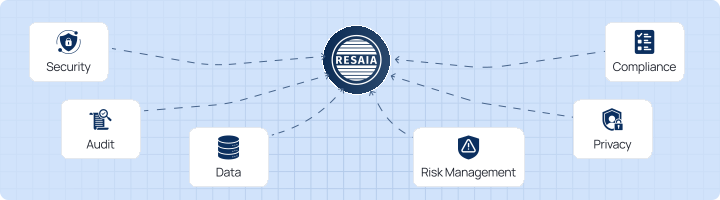
Every governance domain carries a stated scope and stated interfaces. The specification names the outputs each domain produces and the domains that consume them.

Security, audit, data, risk management, privacy, and compliance domains connected through RESAIA.

Principles paired with method

A test, a record, and a lifecycle point

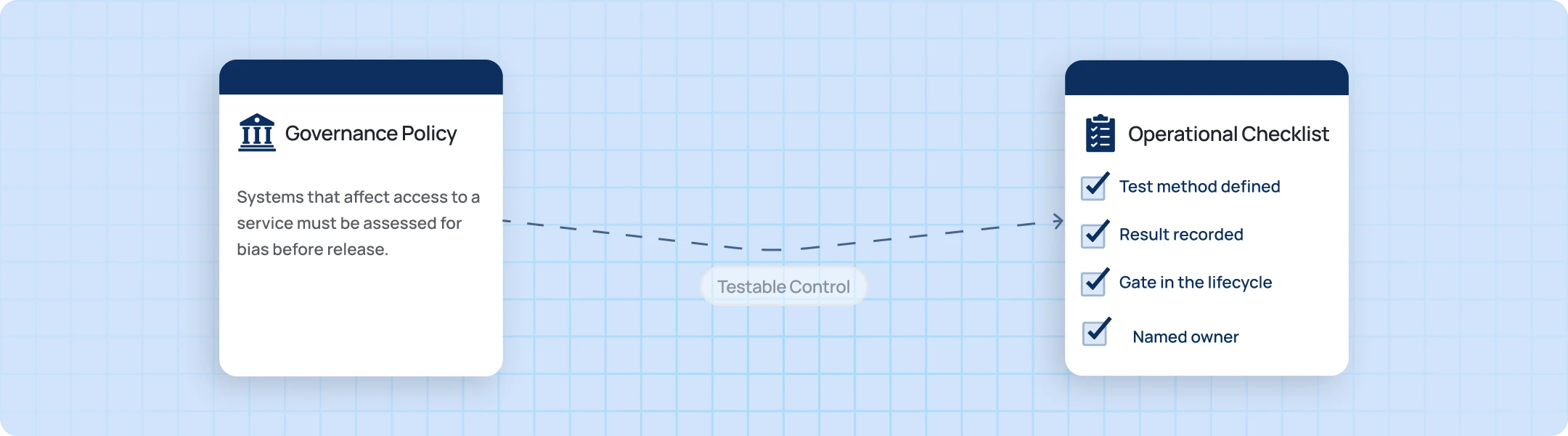
Each principle is paired with a method that tests it, a document that records the result, and a lifecycle point at which the test occurs.

A governance policy turned into a testable control and an operational checklist: test method defined, result recorded, gate in the lifecycle, named owner.

Combined governance traditions

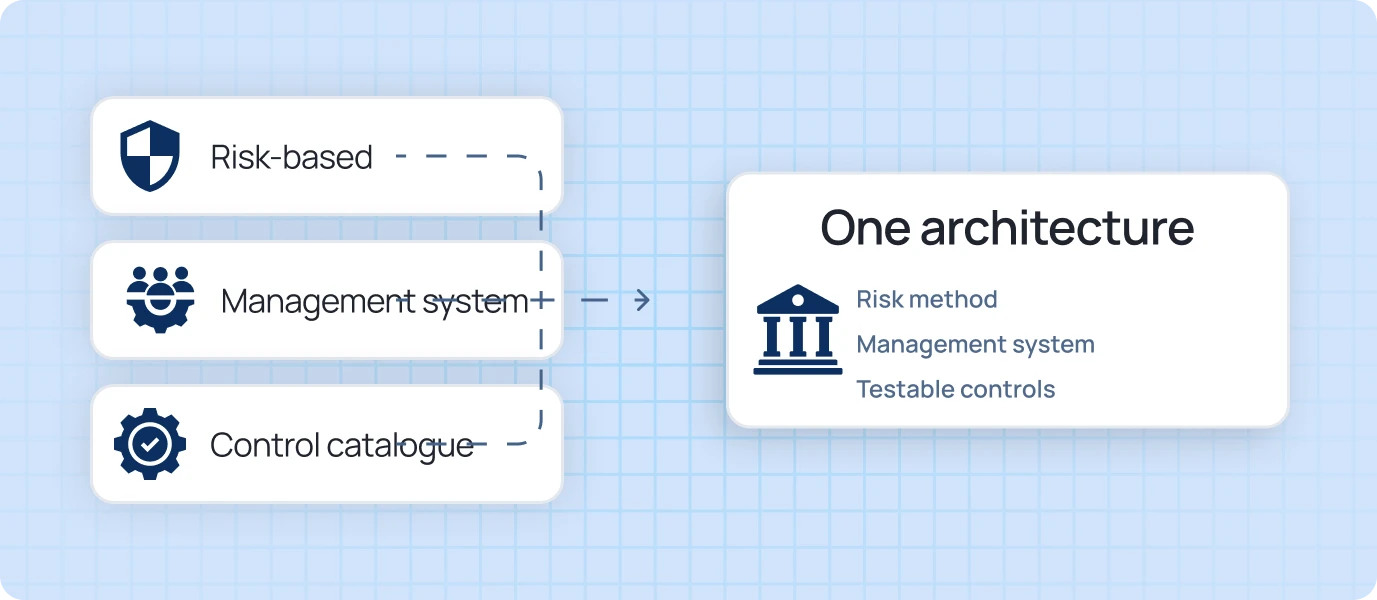
One architecture rather than a choice among three

Risk-based, management-system, and control-based approaches are combined within a single architecture, removing the requirement to adopt one and improvise the remainder.

Risk-based, management-system, and control-catalogue approaches combined into one architecture.

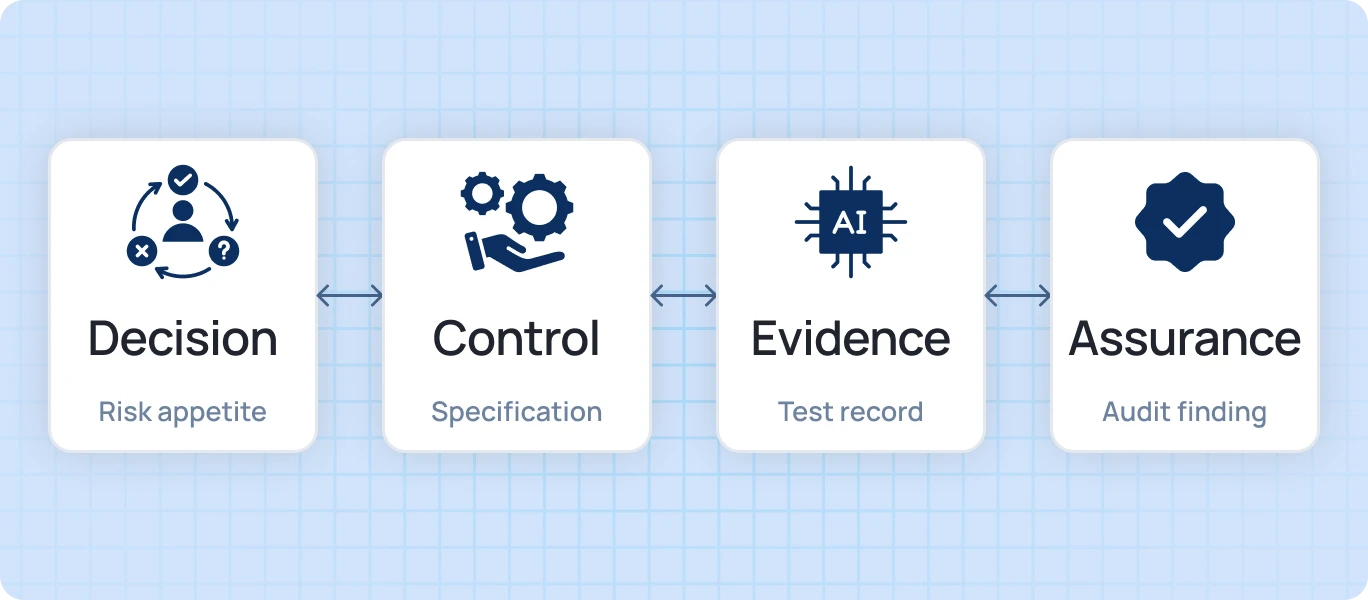
Bidirectional traceability

Board decision to audit finding, in either direction

A decision on acceptable risk connects to the control implementing it and to the audit finding that verifies that control, forming a chain traversable in both directions.

A two-way chain from decision (risk appetite) to control (specification), evidence (test record), and assurance (audit finding).

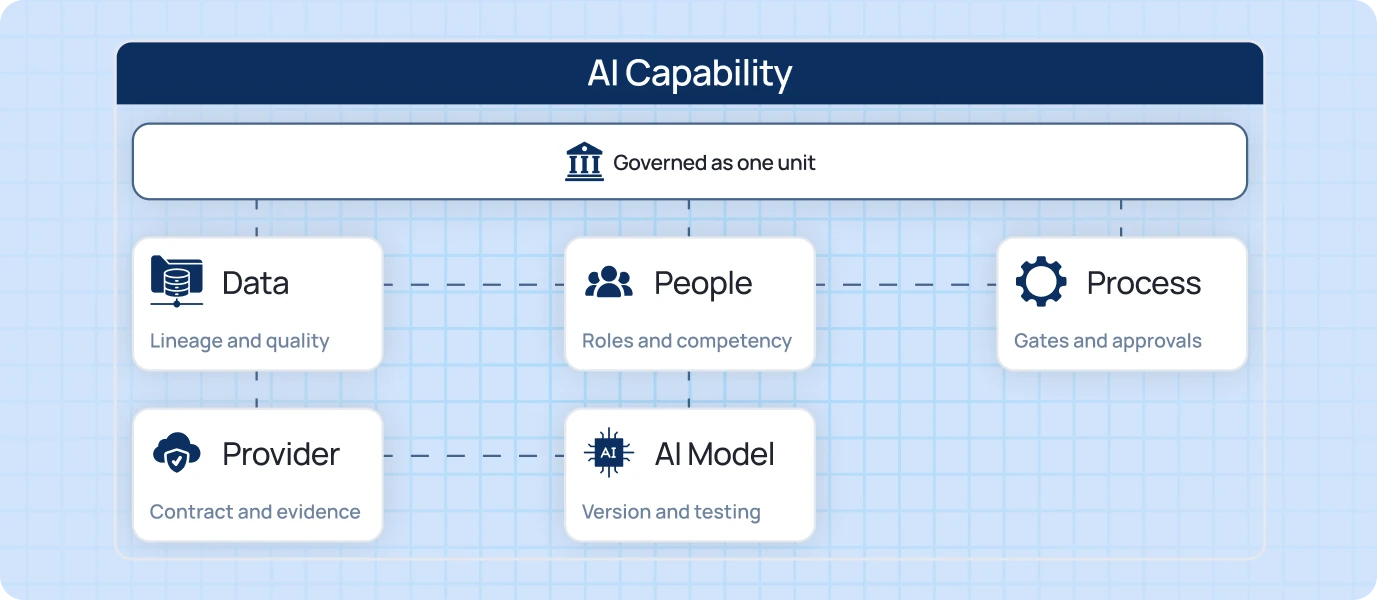
The capability as one unit

Data, personnel, process, and supply chain

The unit of governance is the deployed capability: the data pipeline supporting it, the personnel operating it, the process it executes within, and the suppliers on which it depends.

An AI capability governed as one unit across its data, people, process, provider, and AI model.

The Body of Knowledge

RESAIA AI Governance Body of Knowledge

The Body of Knowledge specifies how AI governance is practised within each discipline and how the disciplines interconnect. Each chapter treats the work the discipline performs, where accountability sits, the risks it must anticipate, the evidence that demonstrates execution, and the criteria distinguishing a mature practice from a nascent one.

The RESAIA AI Governance Body of Knowledge book cover.

The Certifications

Credentials

The Body of Knowledge is the only material needed to prepare.

Level: Foundational

Responsible AI Governance Professional (RAIGP)

Covers the full scope of AI governance: risk, compliance, security, ethics, and legal as one connected discipline. The entry point for anyone entering or working in AI governance.

Anyone entering or working in AI governanceSelf-study from the BOK
View Certification
Level: Specialized

AI Risk Management Professional (ARMP)

AI risk identification, assessment, treatment, and monitoring. Including risks specific to AI such as bias, drift, hallucination, and emergent behaviour in agentic systems.

Risk Managers, Compliance TeamsSelf-study from the BOK
View Certification
Level: Specialized

AI Security Professional (AISP)

Threats to AI systems, including adversarial inputs, data poisoning, prompt injection, and model extraction, and the security controls to address them across the AI lifecycle.

Security professionals, AI engineersSelf-study from the BOK
View Certification
Level: Specialized

AI Audit & Assurance Professional (AAAP)

Independent audit of AI systems, programme design, evidence collection, compliance verification, and conformity assessment.

Auditors, compliance officers, regulatorsSelf-study from the BOK
View Certification
Level: Specialized

AI Privacy & Data Governance Professional (APGP)

Data quality, lineage, privacy, and protection obligations across the AI data lifecycle, from training data through to model outputs.

Privacy officers, DPOs, data governance leadsSelf-study from the BOK
View Certification
Level: Specialized

AI Procurement Professional (AIPP)

AI vendor evaluation, supply chain risk, model provenance, and governance of third-party AI systems and foundation models.

Procurement leads, vendor managers, governance teamsSelf-study from the BOK
View Certification

Certification by area of practice

Each credential covers one area of practice

Individuals certify in the discipline they practise. Organisations use the same material as an assessment instrument, measuring current governance capability against a defined standard.

Entering the discipline

Practitioners moving into AI governance from an adjacent field, or building competency ahead of taking on the accountability.

Risk & Compliance Leaders

Chief risk officers, heads of compliance, and the teams accountable for AI risk methodology, assessment, and enterprise reporting.

Procurement & Vendor Managers

Procurement leads and vendor managers accountable for supplier selection and for governing what those suppliers deliver.

Boards & Policy Makers

Executive committees, board directors, and policy makers accountable for AI strategy, risk appetite, and enterprise governance.

Security & Data Professionals

CISOs, AI security engineers, data protection officers, and data governance leads operating at the technical surface of AI systems.

Auditors & Regulators

Internal and external auditors, conformity assessment bodies, and regulators applying the same architecture as the organisations they oversee.

AI governance is a discipline The knowledge behind it is open

The Body of Knowledge is available to anyone practising AI governance, whatever discipline they entered from.