
Choose Program
Review the role profile and confirm ARMP is the right specialization.



Specialised Certification
AI systems introduce risks that do not exist in traditional IT or operations: bias, drift, hallucination, adversarial manipulation, and emergent behaviour in agentic systems. These risks require their own identification methods, assessment criteria, and treatment approaches. A specialised certification for professionals who need to manage AI risk with methodology that accounts for how AI systems actually fail.
Target Roles
Without AI-specific risk methodology, risk professionals default to one of two approaches. They apply enterprise risk frameworks that treat AI systems like any other technology asset, which misses failure modes like drift, hallucination, and emergent behaviour entirely. Or they defer to technical teams who evaluate model performance in isolation, without connecting it to organisational risk appetite or regulatory obligations.
In both cases, the risk register provides false assurance: it shows risks as identified and managed when the most consequential ones were never captured. Portfolio-level risk accumulation stays invisible because each AI use case is assessed on its own. Boards receive reporting that confirms process compliance while substantive risk goes unreported because no one in the risk function has the vocabulary to surface it. The ARMP certification exists because RESAIA believes this gap is not a tooling problem or a resourcing problem. It is a knowledge problem.
Learning Outcomes
Study Material
The ARMP draws primarily from the BOK's AI Risk Management chapter, with supporting material from AI Strategy and Oversight, AI Ethics, Continuous Monitoring and Drift Detection, and AI Use Case Portfolio Management. The BOK teaches these disciplines not as independent topics but as parts of a connected governance system, so candidates understand where risk management sits within the broader governance architecture and how it depends on and feeds into other disciplines.
Review the role profile and confirm ARMP is the right specialization.

Work through risk identification, assessment, treatment, and monitoring guidance.

Complete the 110-minute online certification assessment.

Receive a three-year professional credential after passing.

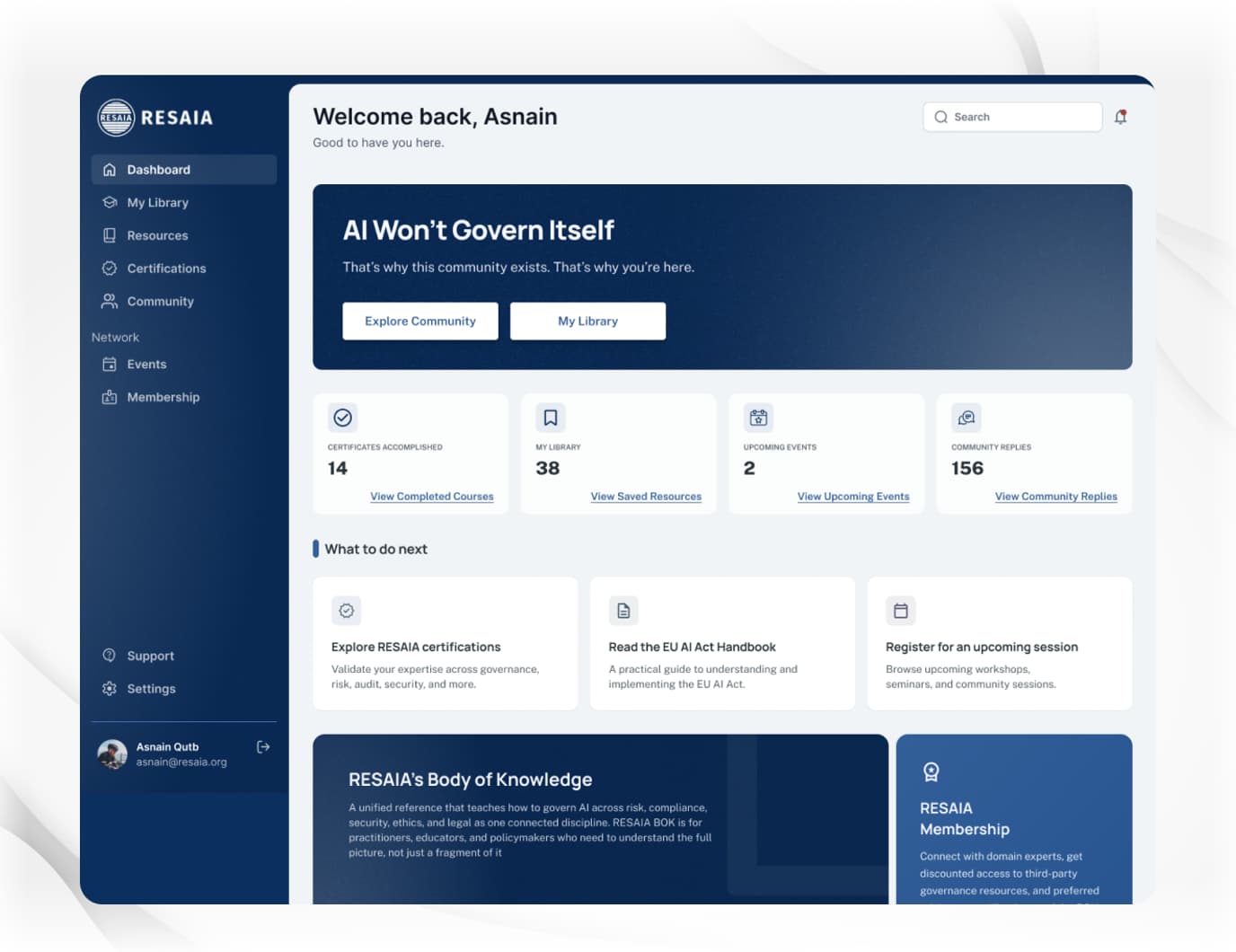

RESAIA exists to make that practice measurable, teachable, and accountable. It gives every discipline that touches AI a shared structure, a shared language, and a shared standard to measure against.